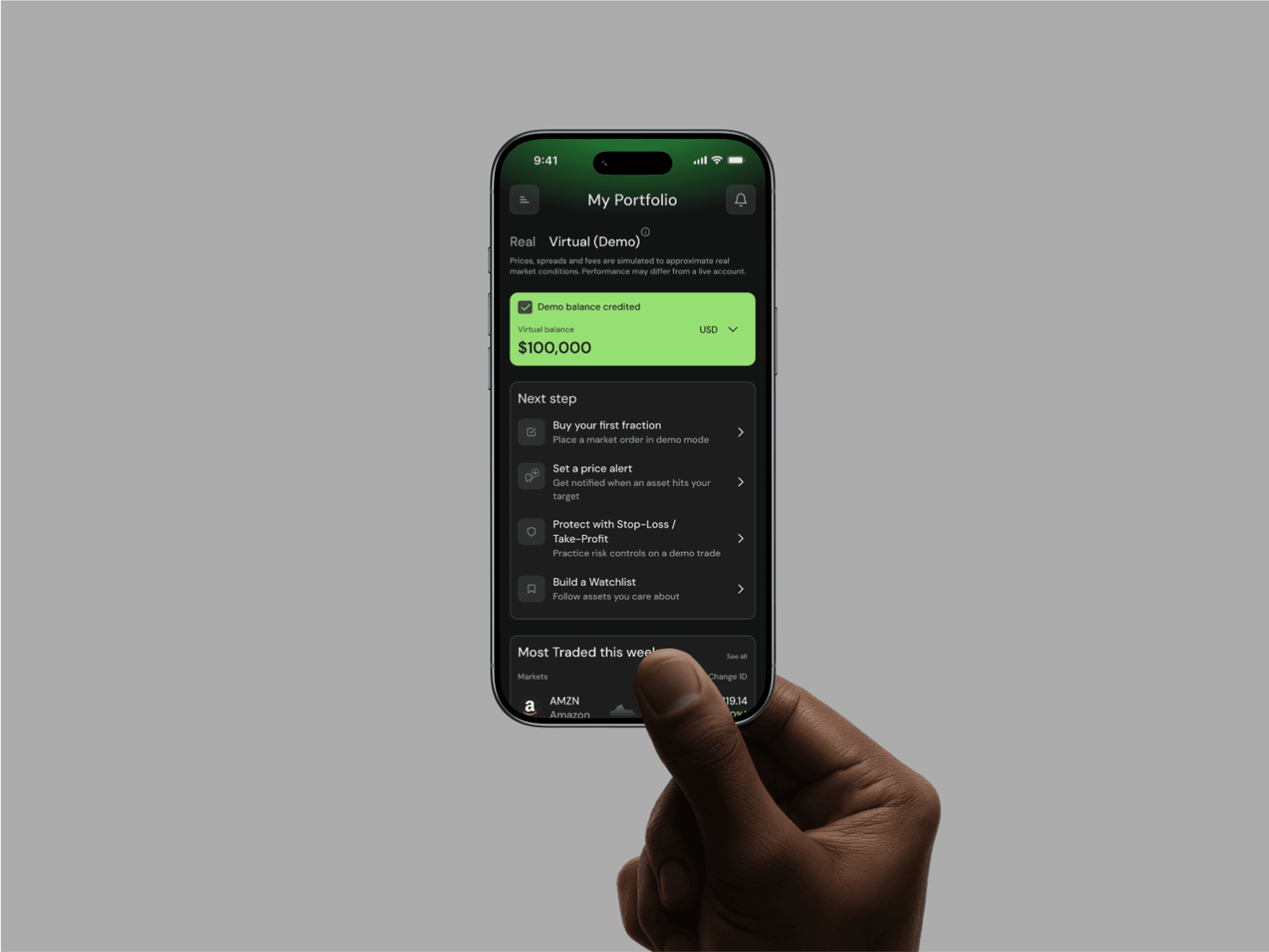
Problem definition & Challenge
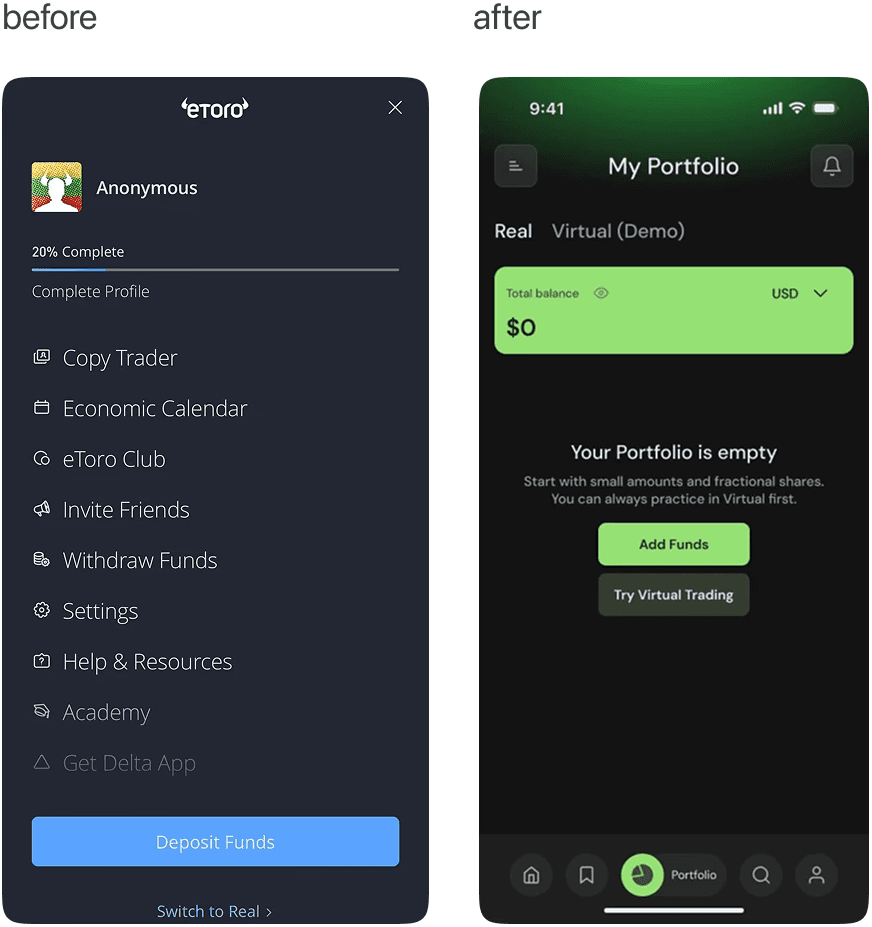
Support tickets and product analytics revealed two core issues: users couldn't find the demo account (or confused it with their real portfolio), and it took too many steps to complete a first trade.
A bad first experience in demo mode is like confusing steps, unexpected losses creates anxiety and drives new users away before they ever try a real account.
📍 Goal
Make the demo account easy to discover, guide new users to their first trade with minimal friction, and clearly differentiate demo from real portfolio — without cannibalising deposit conversion.
Discovery
In a short workshop with stakeholders I defined the demo's core purpose: a safe practice environment before users risk real money. I mapped where users get lost, what blocks the first trade, and why the demo is hard to find. I set release metrics: Demo-to-Trade rate, Demo-to-Real conversion, time to first action, and volume of "how do I enable demo?" support tickets.
Performance had to stay high with an instant Real/Virtual switch; money operations were scoped strictly to the Wallet; iOS patterns needed to stay aligned with the web version.
I gathered current screens and user flows, analytics events, demo entry points, and a gap map between sections (e.g., Portfolio → Discover/Watchlist).
Benchmarking
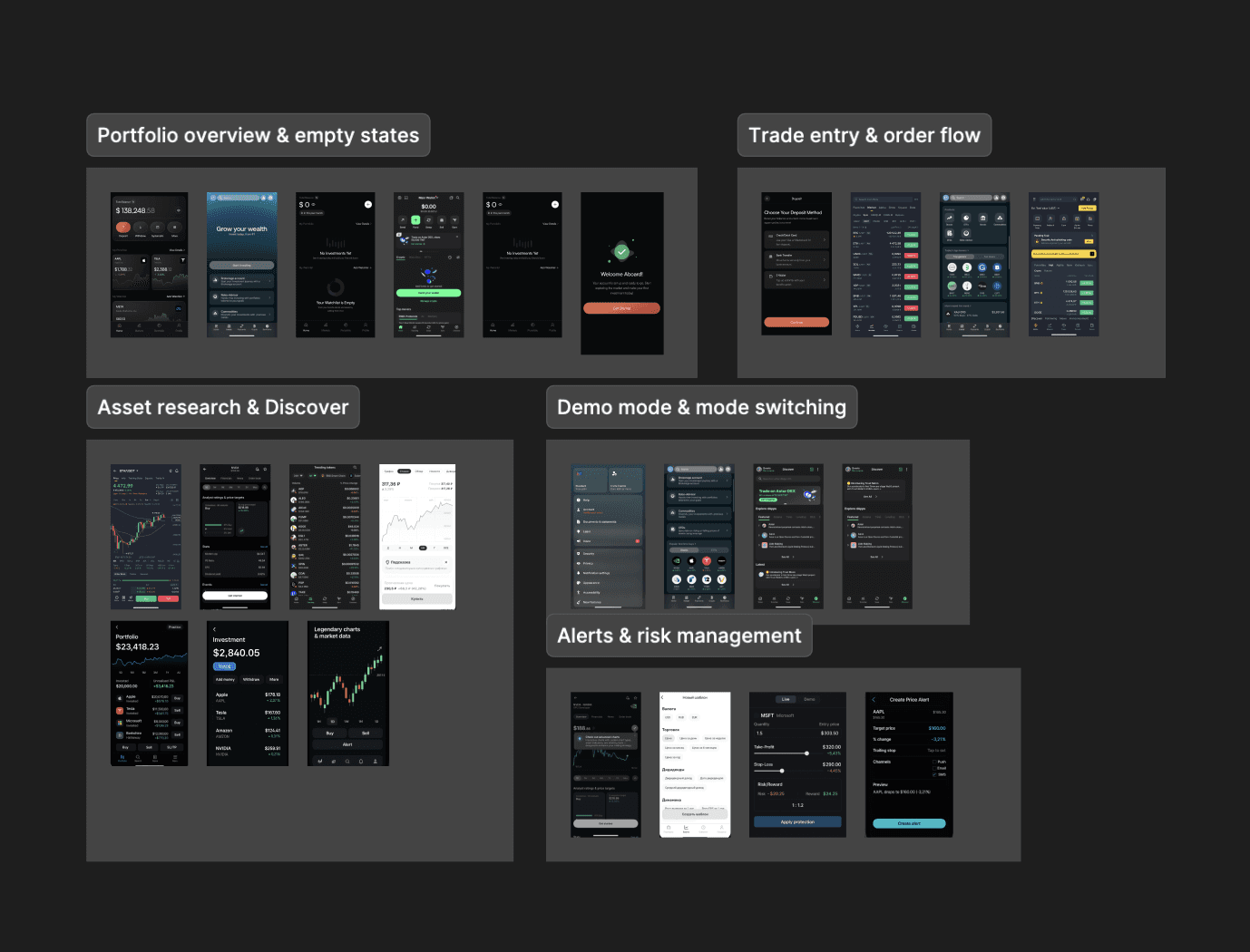
I audited 10+ trading apps and studied four in depth (Robinhood, Revolut, Trading 212, and Webull) benchmarking each against our goals: first-time user experience, mode separation and speed to action.
Robinhood – transparent portfolio view (total balance + chart) with quick actions on asset cards. I adopted the chart-and-total layout on the main screen and inline quick actions, while keeping the metric count minimal to avoid overload.
Revolut – strong empty states with clear calls to action; precise number and currency formatting. I adopted instructional empty screens and localized number/currency patterns. I avoided mixing money management and investments on one screen.
Trading212 – clear separation of practice and real modes with persistent mode badges; Invested and P&L always visible alongside the chart; simple closed-position history. I adopted labels like Total Invested and (Un)realised P&L plus a mode badge on every screen.
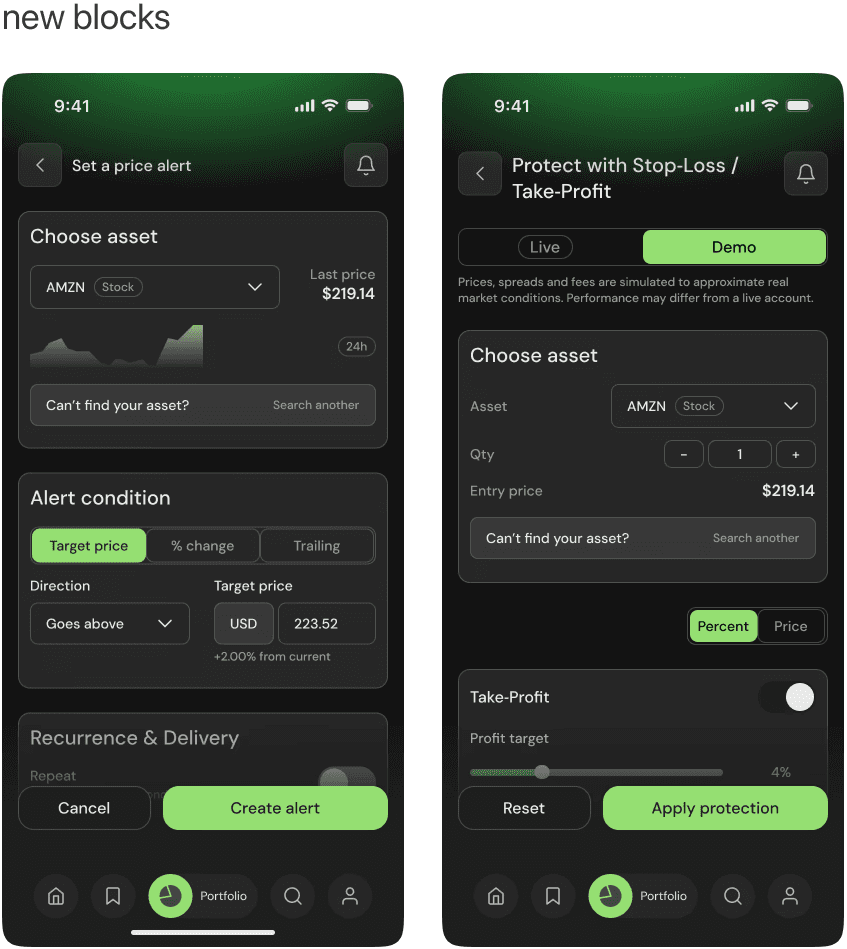
Webull – paper trading as a full-fledged mode, a flexible alerts wizard, and protective orders with a risk/reward card. I adopted the alerts-wizard pattern and stop-loss/take-profit with a risk/reward preview.
What I took away
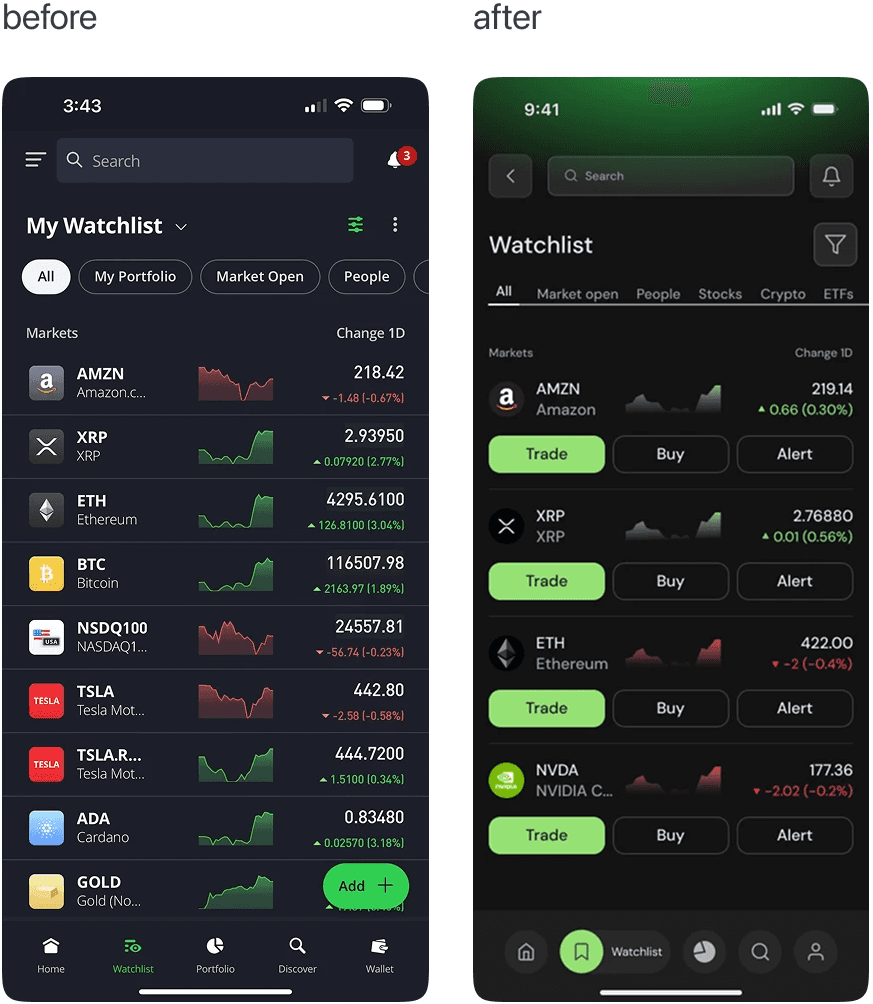
The demo should be a full-screen mode with its own clear badge. Asset cards should carry inline actions (Buy / Alert / SL-TP), and empty states should double as mini-onboarding steps. Alerts bring users back at the right moment.
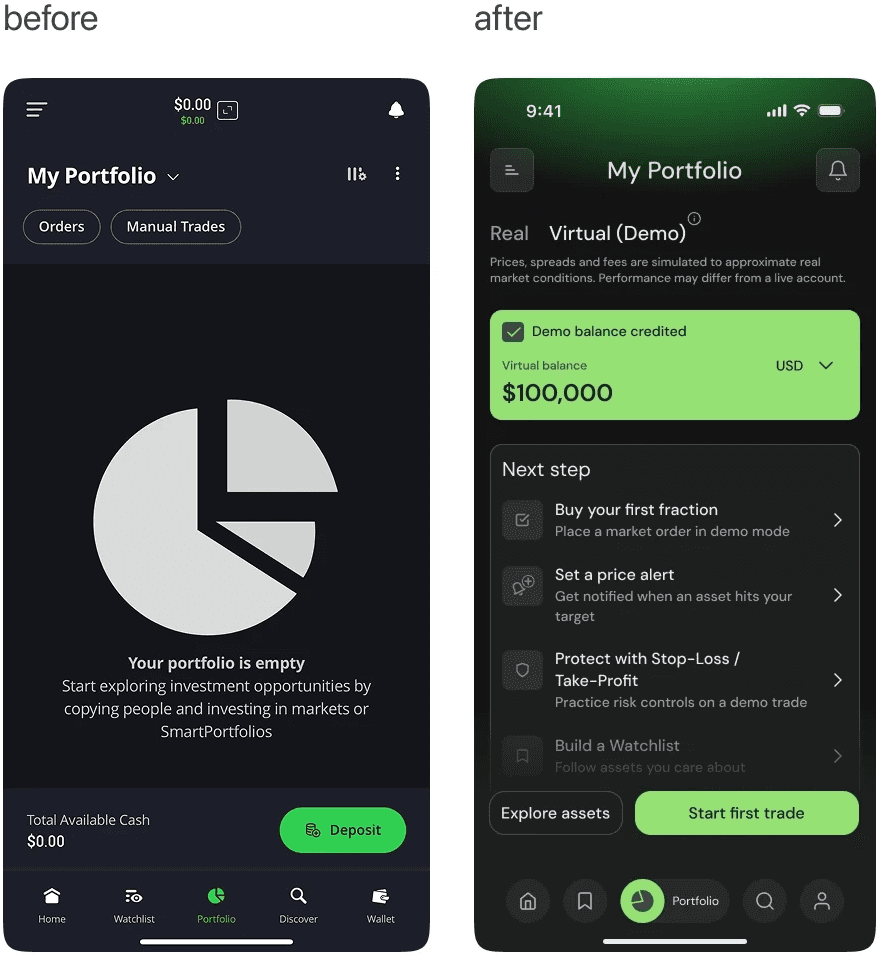
From this analysis we shaped a focused product hypothesis: moving the demo switch to the header, adding a short first-time checklist (FTUE), and placing quick actions on cards would shorten the path to placing an order and improve conversion to real mode without pushing deposits.
Research & hypotheses
Methods: Short interviews with new and experienced users, two rounds of moderated usability tests (screen and time recording, HEART framework), and funnel/support-ticket analysis.
📍Hypotheses
1. Moving the demo switch to the header will make it immediately visible and reduce mode errors.
2. An FTUE checklist will help users reach the target action faster.
3. Adding a mini-portfolio chart and extra metrics (day change, 1W/1M) to the first demo screen will motivate quicker action.
4. Inline quick actions on asset cards (Trade / Buy / Alert) will shorten the path to the target action.
Findings:
✅ H1 Confirmed: participants noticed the header switch right away and consciously verified their mode before acting.
✅ H2 Confirmed: the FTUE checklist accelerated the path to the target action. Users tapped "Start," followed deep-linked steps, returned with progress marked, and switched to the real portfolio more often.
❌ H3 Not confirmed: a mini-chart and extra metrics on the first screen distracted users rather than motivating them; no measurable speed improvement.
✅ H4 Confirmed: inline quick actions shortened the path significantly. Users acted directly from the asset list and rarely needed the back button.
Wireframes
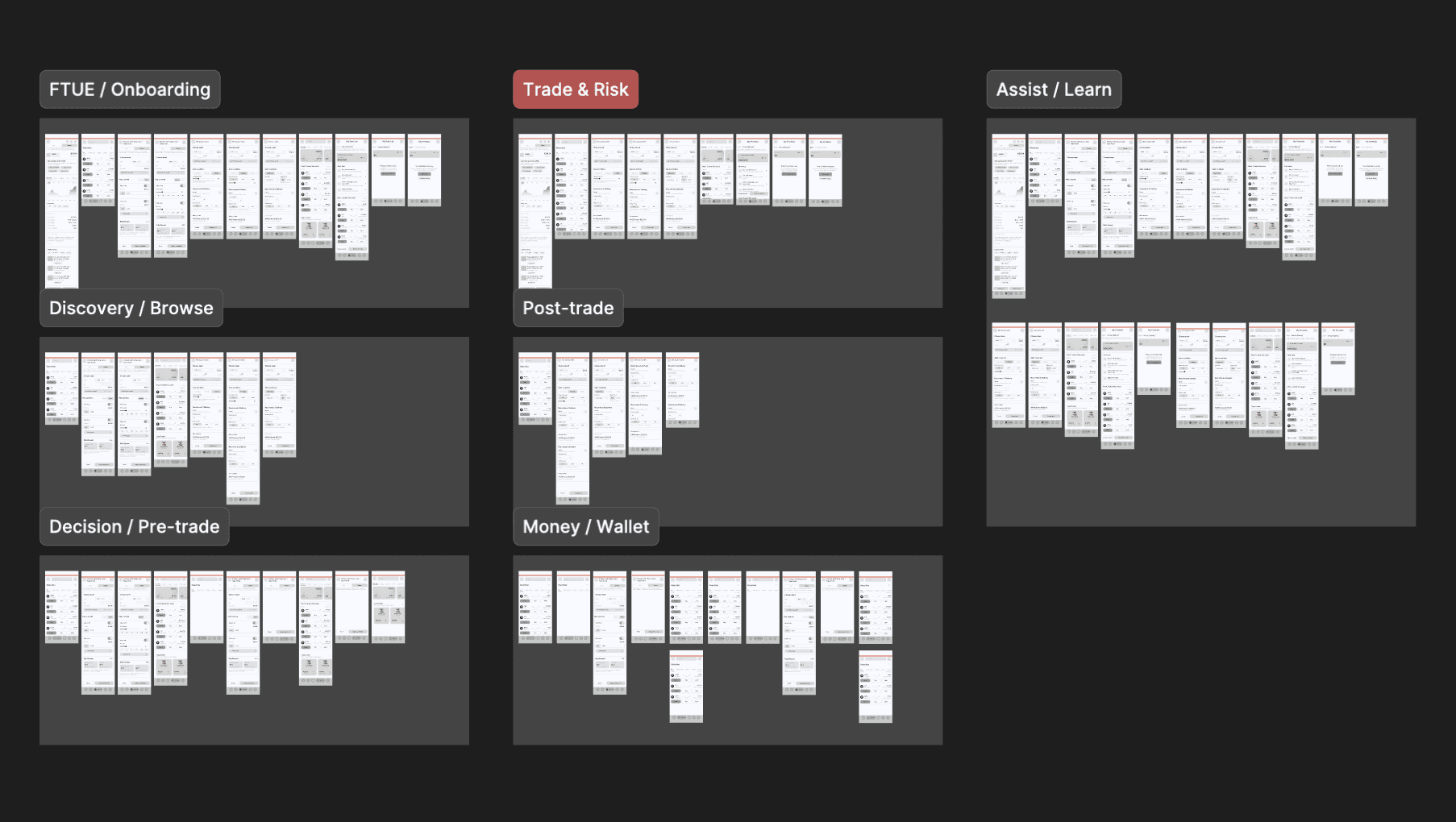
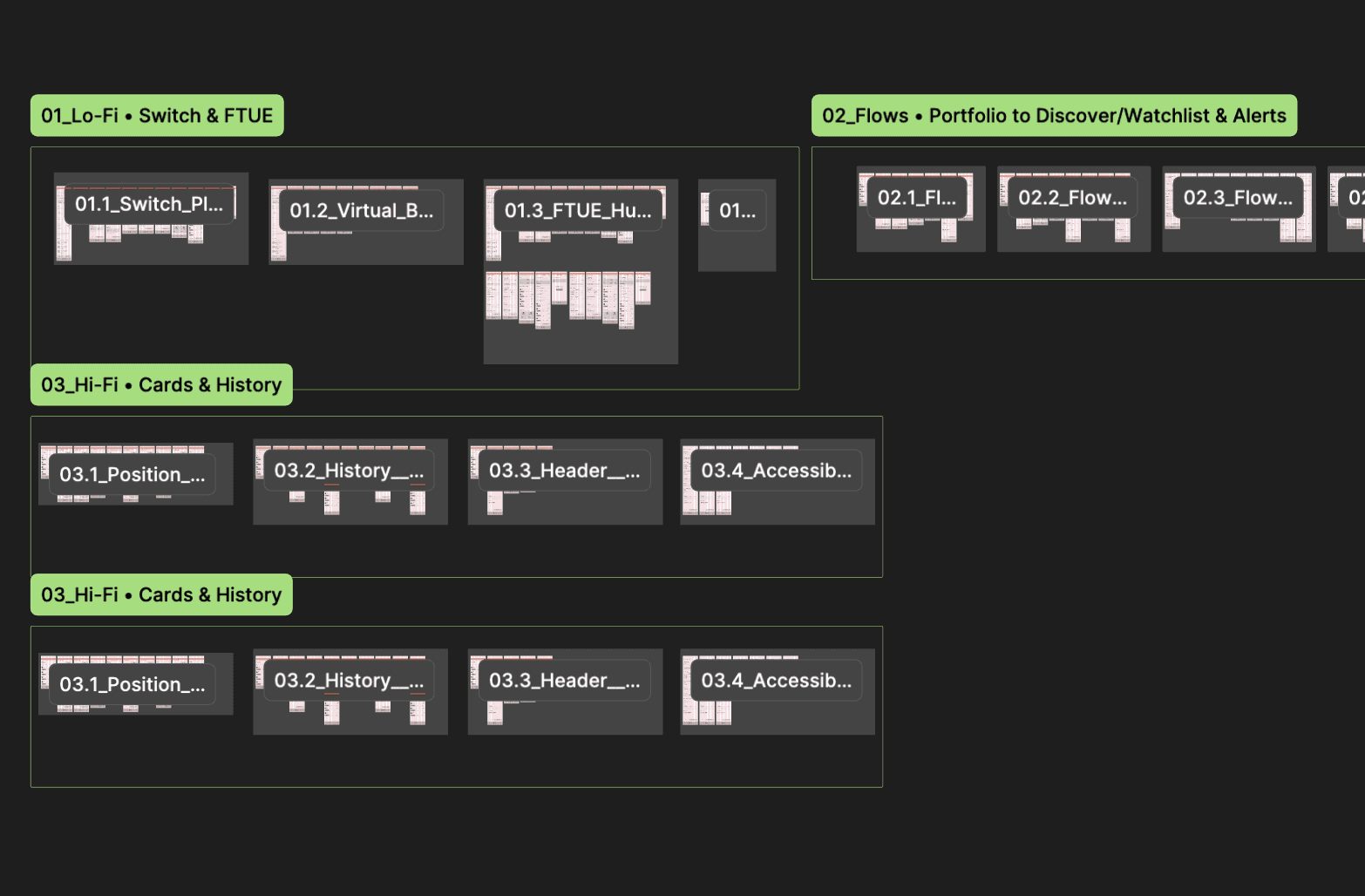
Low fidelity placement of the Real/Virtual switch, virtual-balance chips, and the FTUE hub; flows from Portfolio to Discover and Watchlist; alerts wizard and SL/TP ticket.
High fidelity position cards with mini-charts and quick CTAs; open/closed tabs in history; refined spacing and typography.
Usability & A/B tests
Usability tests (two rounds) – The goal was to find breakdowns in the first steps (FTUE) and the visibility of key controls; we used moderated tasks with screen/time recording and the HEART framework. Results: the header switch removed confusion; the checklist guided users through steps; quick actions shortened the path; an overloaded FTUE slowed the start.
A/B tests – Split traffic 50/50 to see which changes speed up the first step without hurting deposits. Measures included Demo to Trade, Demo to Real, time to first trade, mode errors and deposit conversion. Results: the header switch reduced errors; auto‑DEMO and a short FTUE accelerated start without hurting deposits; a light checklist was better than an overloaded one; Buy/Alert/SL‑TP buttons increased actions and alerts.
Metrics (4–6 weeks after release)
Demo‑to‑conversion rate: +17 % We compared the conversion rate of users who practiced in Demo and then moved to a live account (funded their balance and placed at least one trade). The result was a 17% increase.
Time to first trade: 21 % faster For each cohort, we took the median time (in hours) and compared before vs. after. After the redesign, users placed their first trade 21% faster.
DAU in Portfolio: +6 % We measured average DAU over 4–6 weeks before and after release; DAU increased by 6%.
NPS: +8 points NPS was calculated using the standard formula (percentage of promoters minus percentage of detractors) based on in-app surveys. The +8-point change reflects an improved experience in the new version.
Day‑30 retention (new users): +4 % The share of new users who returned to the app after 30 days increased by 4%.
Support requests about modes: –25 % The number of support tickets about how to switch between Demo/Live dropped by 25% over the month, indicating a clearer and more understandable UI.